
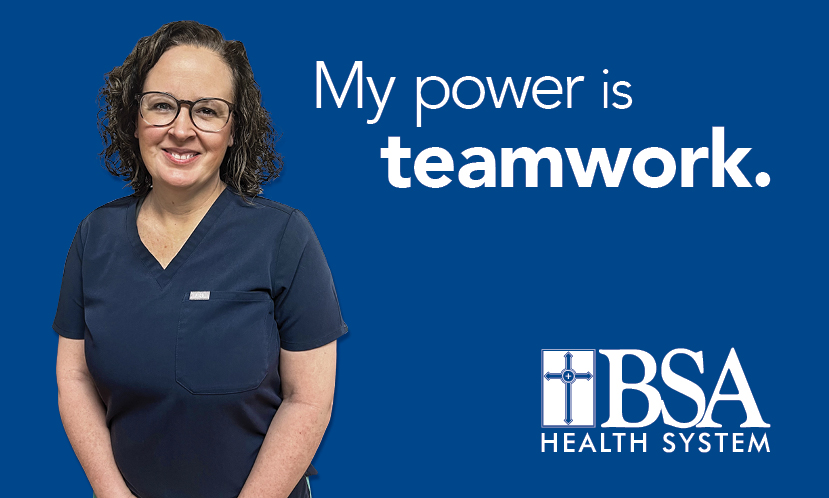
Most mothers will tell you that they vividly remember the day they gave birth. It’s not surprising – child birth is a memorable experience often colored by stress and happiness in equal parts. But at BSA Health System, one nurse is going above and beyond to ensure mothers and babies are cared for every step of the way.
From an early age, Jennifer Peters knew she wanted to be a nurse. In high school, her aunt invited Peters to come along with her to prenatal classes, knowing Peters wanted to go into the medical field. When it was time to give birth, Peters was present at her aunt’s delivery.
“I just remember that so vividly,” said Peters. “I was speechless. That was kind of the start of everything.”
Peters attended Amarillo College and got her associate degree in nursing. But her education didn’t stop there. After getting married and starting a family of her own, Peters decided to return to school and received a bachelor’s degree at West Texas A&M in Canyon, Texas. From there, she pursued multiple certifications, including a fetal monitoring and inpatient obstetrics, to further her education in labor and delivery.
“I just wanted more knowledge,” said Peters. “We have to renew those [certifications] every three years and do extra continuing online education (CEU) for those on top of our nursing degrees. I’m one of the older nurses on the floor so I kind of mentor the younger ones and bring out the new evidence-based practices because it’s ever-changing.”
Peters has worked at BSA for 30 years with 28 in labor and delivery. During her tenure, she has been a charge nurse, educating other nurses and precepting new hires. Last year, BSA initiated a new high-risk flight obstetrics (OB) team on which Peters serves.
“Every day is rewarding, because most moms are in such a vulnerable state,” said Peters. “The internet can give them bad information and they’re terrified when they come into the hospital. I try to give them calmness and let them know that I’m going to let them know if I’m worried about something. I always tell new nurses that most moms only have two or three babies. They always remember the birthing experience. And I want to be in that positive realm.”
When she’s not at the labor and delivery unit, Peters acts as an Association of Women’s Health, Obstetric and Neonatal Nurses (AWHONN) instructor teaching advanced and intermediate fetal monitoring. She teaches roughly 15 classes a year both at BSA and other facilities nearby.
“We’re in Amarillo, Texas so there are a lot of rural communities,” said Peters. “I also go to outlying hospitals and give them this [education] so they can be proficient in fetal monitoring and give them the empowerment knowing what to do.”
Empowering people is a key part of what makes Peters such a successful and beloved nurse. With recent nursing graduates, Peters acts as both a mentor and a friend.
“My goal for this year was to be a mentor to the new nurses, so I frequently check in with them and let them know they have somebody they can call, even in the middle of the night, if they have an issue,” said Peters.
Peters’ commitment to nursing has won her acclaim in Texas. In 2021, she was named one of the Panhandle Great 25 Nurses. Winning this award involves a rigorous voting process by an esteemed selection committee who awards nurses based on their leadership qualities, service to the community, compassion as caregivers and contributions to the nursing profession.
“It is very prestigious and I was very honored,” said Peters of this award.
She also serves as a member of the Texas Panhandle Nurse Honor Guard. This nonprofit organization is made up of active and retired professional nurses who volunteer their time to provide memorial services to fellow nurses who have passed away.
“It just gives you a sense of worthiness,” said Peters about her nursing career. “I could have stayed home with my kids, but I felt like it was my calling. That God wanted me to be a nurse for this community and for our new nurses.”
Still, Peters understands that nursing is not for the faint of heart.
“It’s a hard field, but very rewarding,” said Peters. “It can be, for new nurses, very downgrading sometimes. I don’t want them to leave. Nursing’s very much needed and short-handed, and I want to produce nurses because I’m not going to be here forever. I want to produce nurses that are like me – I hope – to take care of the next generation of patients.”