

By Eddie Copelin, M.D., MHA
Digestive Health Center – Amarillo
One of the most common conversations I have with patients at the Digestive Health Center in Amarillo usually starts the same way: “Do I really need a colonoscopy if I feel fine?”
It is a fair question and an important one; I’ll walk you through how I usually answer it in the exam room.
The big picture
Before I became a gastroenterologist, I served in the United States Marine Corps and deployed to Operation Iraqi Freedom. After my service, I worked as an emergency medical technician (EMT) in the civilian sector. Those experiences shaped how I think about taking care of people.
As an EMT, I often saw patients when something had already gone wrong. We were responding in the moment, trying to manage problems that had progressed. What drew me to gastroenterology was the chance to change that. Instead of reacting, I wanted to help prevent those situations in the first place.
That is exactly what a colonoscopy allows us to do. When I recommend a colonoscopy, it is usually not because I think something is wrong. Most of the time, it is because I want to keep you healthy and catch anything early.
Colorectal cancer is one of the few cancers we can actually prevent. During a colonoscopy, we can find and remove small abnormal growths called polyps that are pre-cancerous or cancerous. That is why this matters; early prevention and detection.
“But I feel fine”
I hear this all the time from patients and I understand it. If nothing feels off, it can be hard to see why an evaluation is necessary. The challenge is that many digestive conditions, including colon cancer, do not cause symptoms early on. By the time someone notices something, the disease may already be more advanced.
When I bring up screening, I am not responding to symptoms. I am trying to stay ahead of them. That is what prevention looks like.
When should you think about a colonoscopy
For everyone turning 45, colonoscopy is still the “gold standard” for colorectal cancer screening. Some patients may need to start earlier depending on family history or other health factors.
For example, the American College of Gastroenterology recommends screening at age 40 for people with one or two first-degree relatives with colon cancer or advanced colon polyps.
At the Digestive Health Center, these conversations are always personal. My goal is to help you understand your risk and make a plan that makes sense for you.
What everyone worries about
This is usually when patients ask about the prep or the procedure itself. I will be honest with you; colonoscopy prep is not everyone’s favorite part. But, with recent pharmaceutical advances, it has gotten easier over time. We have many options including liquids and pills, and most people handle it better than they expect.
The procedure itself is often not what people think. You are sedated and comfortable. Most patients do not remember it at all. It is also quick and you go home the same day.
What I tell patients is simple. The prep is temporary, but the peace of mind and protection you get from screening lasts much longer.
A missed opportunity
From my time as an EMT to my work now, I have seen what happens when care comes too late. Some of the hardest moments in my clinic are when we find something that could have been prevented with earlier screening.
Those are the situations I think about when I encourage patients not to wait. If there is one thing I want you to take away, it is this: You do not have to wait for something to feel wrong to take care of your health.
Taking the first step
If you are 45 or older or even if you have just been thinking about your digestive health, get it checked out. At the Digestive Health Center in Amarillo, we have these conversations every day. They are straightforward and focused on helping you stay healthy.
Your digestive health plays a bigger role in how you feel than most people realize, and sometimes the most important step is just starting the conversation.
Click here to learn more and schedule your colonoscopy.
About Dr. Copelin
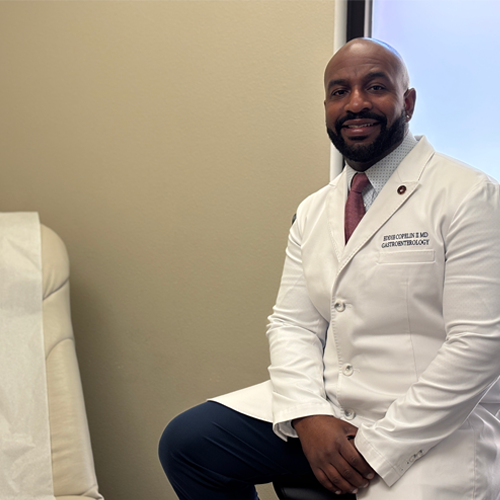
Dr. Eddie Copelin is a gastroenterologist at the Digestive Health Center in Amarillo. As a former Marine and EMT, he brings a prevention-focused and patient-centered approach to care, helping patients stay ahead of digestive conditions through early detection and education.